

Over time, drinking alcohol can cause memory loss that’s difficult to repair. Chronic alcohol consumption affects the brain in countless ways, including impairing memory. While some people forget details about a night of binge drinking after a blackout, drinking alcohol may cause long-term permanent memory loss, even affecting your ability to remember things you learned years ago.
How Alcohol Affects the Brain
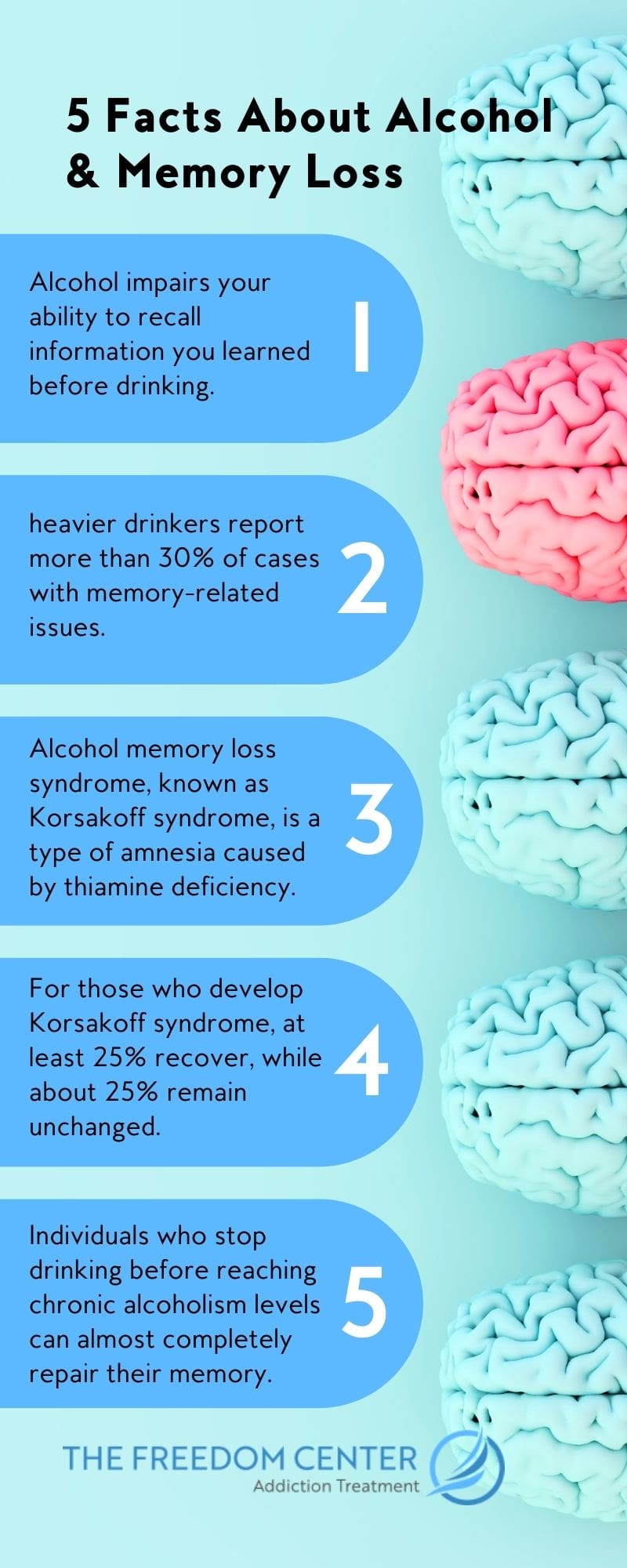
Alcohol impairs your ability to recall information you learned before drinking. This includes events from yesterday and earlier in life, such as your childhood or adolescence. It’s not uncommon for people who drink heavily over a long period to experience blackouts where they have no recollection of certain parts of their lives.
In addition, alcohol affects your ability to learn new information. While you’re drinking, you may find yourself having trouble remembering things that happened just moments ago. But this kind of impairment is not just limited to short-term memory; it also affects long-term memory.
One study found that heavy drinkers have altered brain chemistry that inhibits their ability to process certain types of information, including new experiences and facts about themselves.
Alcohol Consumption Habits and Memory
When it comes to alcohol memory loss, a night of binge drinking isn’t enough to cause permanent damage.
On average, heavier drinkers report more than 30% of cases with memory-related issues compared to someone who doesn’t drink.
Studies suggest people who report higher levels of alcohol consumption are more likely to miss important dates and appointments, forget to pay bills on time, and struggle with remembering important information. Even those that report a healthy drinking limit still have higher memory loss issues than non-drinkers.
What is Alcohol Memory Loss Syndrome?
Alcohol memory loss syndrome, known as Korsakoff syndrome, is a type of amnesia caused by thiamine deficiency. It can be caused by alcoholism or other chronic conditions resulting in malnutrition, such as celiac disease and Crohn’s disease. Symptoms of Korsakoff syndrome include:
- Inability to remember recent events
- Long-term memory gaps
- Difficulty learning new information
- Hallucinations
- Confabulation
- Short-term amnesia
Alcohol memory loss occurs in phases. The first stage is Wernicke encephalopathy, a related disorder that sometimes evolves into Korsakoff syndrome. Left untreated, it can cause death in up to 20% of cases and progress to Korsakoff syndrome in 85% of survivors.
During the first stage, Wernicke encephalopathy causes abnormal eye movements, lack of coordination, confusion, and severe memory problems. For those who develop Korsakoff syndrome, at least 25% recover, while about 25% remain unchanged. This means they’ll struggle with alcohol memory loss syndrome symptoms for years.
Is Alcohol Memory Loss Reversible?
Once you stop drinking, your overall health will improve over time, and so will the health of your brain. While we don’t know precisely how long it takes for all effects of heavy drinking to disappear from the body, research suggests that some changes are reversible after one year without alcohol use.
The sooner you start taking steps to recover from cognitive impairment, the better your chances of recovering fully.
Studies show that individuals who stop drinking before reaching chronic alcoholism levels can almost completely repair their brains’ ability to remember things. While some studies have found evidence of alcohol-induced brain damage that remains even after an individual stops drinking, other analyses suggest that this damage may be reversible.
Because so many factors – including age, sex, biology, and genetics – play a role in recovery, it’s challenging to precisely say how long or if someone will recover.
Nonetheless, the best treatment for alcohol memory loss is to start thiamine deficiency treatment under the supervision of a medical care provider. In addition, it’s essential to abstain from alcohol and maintain a healthy diet for effective long-term recovery.
Because those with Korsakoff syndrome have a reduced tolerance for alcohol and may be at high risk for further alcohol-related health problems. Most people will need long-term residential care to address comorbidities and alcohol use disorder.
Getting Help for Chronic Alcohol Use
If you’ve experienced memory loss from alcohol use, it’s essential to seek treatment as soon as possible. If you suspect that a loved one is experiencing memory problems due to drinking, they may need your help in seeking treatment. Talk to your primary healthcare provider or an addiction specialist to learn more about the available treatment options.
Sources:
https://www.niaaa.nih.gov/publications/brochures-and-fact-sheets/hangovers
https://doi.org/10.1007/s00213-015-4145-1
https://www.alz.org/alzheimers-dementia/what-is-dementia/types-of-dementia/korsakoff-syndrome